Radiator Buying Guide

A practical guide to choosing the right radiator for your home, covering types, sizing and heat output, plus what we stock at our Hereford and Ross-on-Wye trade counters.

Choosing the right radiator comes down to two things: getting the heat output right for the room, and picking a type that suits the space and your heating system. Undersize it and the room never quite warms up. Oversize it and you’re paying to heat air nobody needs warmed. This guide covers the main radiator types, how output is measured, and what to think about before you buy.

In This Guide

What type of radiator do I need?

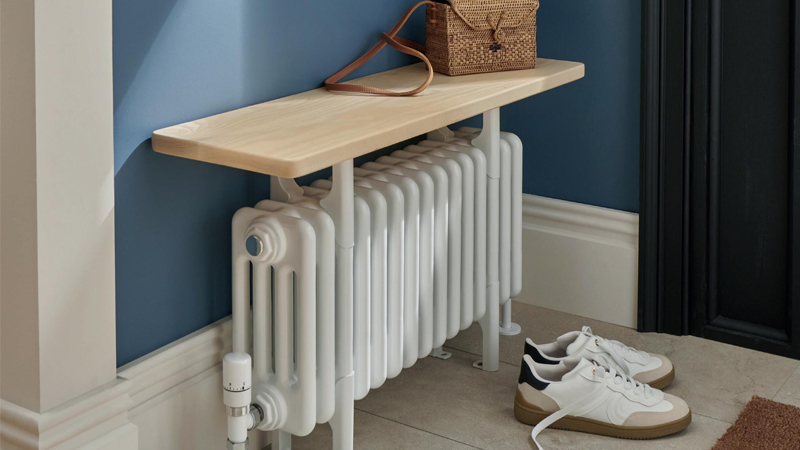
Panel radiators are the most common choice, budget-friendly, widely available, and suitable for most rooms. Column radiators suit period or character properties, and generally offer higher heat output for their size than a standard panel. Designer and vertical radiators work well where floor or wall space is limited, functioning as a feature as much as a heat source. Towel radiators are built specifically for bathrooms, combining heating with somewhere to dry towels.

How radiator output is measured

Radiator output is measured in BTU (British Thermal Units) or Watts, the older imperial and newer metric measurements for the same thing. Most manufacturers list both figures, so you can compare radiators directly regardless of which unit you’re more familiar with.

Sizing a radiator for your room

Getting the size right depends on room dimensions, insulation, window size and count, and ceiling height, so a precise figure needs a proper calculation rather than a rule of thumb. As a starting point:

Room type Rough guide Notes
Bedroom Lower output Usually one external wall, lower heat loss
Living room Higher output Often larger windows and more time spent in the room
Kitchen Lower output Benefits from ambient heat from cooking and appliances
Bathroom Higher output, or a dedicated towel radiator Tiled surfaces and ventilation increase heat loss

These are starting points, not a substitute for a proper calculation. Bring in your room dimensions and our team can help you work out actual output before you buy.

Radiator types compared

Type Best for Notes
Panel radiator Most rooms, budget-conscious buyers Widely available, straightforward to fit
Column radiator Period or character homes Higher heat output per size, traditional look
Designer/vertical radiator Space-saving, feature wall Higher cost, doubles as a design piece
Towel radiator Bathrooms Combines heating with towel drying

FAQs

Do I need a plumber to fit a new radiator?

Fitting a radiator involves working with your heating system’s water, and usually means draining and refilling part of the system, so it’s best left to a qualified heating engineer, particularly if pipework needs to move.

Both measure heat output. BTU is the older imperial unit, Watts the metric equivalent, and one Watt is roughly 3.4 BTU per hour. Manufacturers usually list both so you can compare either way.

Usually fine if the room hasn’t changed, but worth checking if you’ve since improved insulation or changed windows, since an older radiator may now be oversized for what the room actually needs.

Need to check what we have in stock?

Call your nearest branch and our trade team will help, Hereford or Ross-on-Wye.

Hereford Branch

Westfields Trading Estate, 1 Faraday Road, Hereford, HR4 9NU.

Mon–Fri 7:30am–5:30pm · Sat 8am–12pm

Ross-On-Wye Branch

Ashburton Ind Est, Unit 1 Great Western Ct, Ross-on-Wye. HR9 7XP.

Mon–Fri 7:30am–5:30pm · Sat 8am–12pm

We don’t list individual products or prices online. Call your nearest branch and our trade team will help. We can check stock and have your order ready to collect.

News & Guides

Need to check stock or get a price?

Call your nearest plumbing and heating branch. Our trade team can check availability, advise on the right product and have your order ready to collect.